

Table of Contents
- Why Verifying a Mechanic’s Credentials Matters
- What You Need Before You Start an Alberta Tradesperson Lookup
- How to Verify a Journeyperson Certificate in Alberta Step by Step
- AMVIC Inspection Mechanic Qualifications Explained
- Distinguishing Mechanic Trade Credentials and Endorsements
- What to Do When a Search Returns No Match or Conflicting Details
- Credential Verification vs Assessing Work Quality
- Privacy, Consent, and Using Public Registers Responsibly
- Building Credential Checks Into Your Routine
- Frequently Asked Questions
Last Updated: October 9, 2026
Why Verifying a Mechanic’s Credentials Matters
When you hand your keys to a mechanic, you’re trusting them with your safety, your budget, and your peace of mind. Learning how to verify journeyman mechanic credentials protects you from costly mistakes and unqualified work.
At Vehicleinspectionservices, our journeyman-certified mechanics work across Alberta every day. We know firsthand why credential checks matter. This guide walks you through the exact steps to confirm a mechanic’s certification.
The stakes go beyond a bad repair. Unqualified work can void warranties, fail safety inspections, and put you at risk on the road. A few minutes of checking now saves thousands later.
What You Need Before You Start an Alberta Tradesperson Lookup
An Alberta tradesperson lookup is a public search that confirms whether someone holds a valid trade certificate in the province. You don’t need an account or special access. You just need the right details.
Information to Have on Hand
Gather these before you begin:
- The mechanic’s full legal name
- Their certificate number, if you have it
- The trade designation, such as automotive service technician
A certificate number makes the search faster and more accurate. Without it, a name search still works, but common names can return several matches.
Where to Search
Alberta’s apprenticeship and industry training authority maintains an online lookup tool for public credential checks. The tool lets you confirm certification status, apprentice registration, and Red Seal endorsement.
For employers, this is the fastest path to confirming a hire’s credentials. For consumers, it’s a quick way to vet a shop before booking work.
How to Verify a Journeyperson Certificate in Alberta Step by Step
A certificate of qualification is issued by a province or territory, not by a national body, so the first question is always: which jurisdiction certified this mechanic? Once you know that, you go to that jurisdiction’s apprenticeship and trades authority and use its public register. The steps below work for any province or territory; the authority name is the only thing that changes.
- Ask the mechanic which province or territory issued their certificate of qualification, and write down the trade designation exactly as it appears on their documents.
- Open that jurisdiction’s apprenticeship and trades authority website and find its public credential or tradesperson register.
- Choose name search or certificate number search. A certificate number is faster and avoids common-name collisions.
- Enter the details exactly as they appear on the certificate, including middle names and any hyphenation.
- Read the record: confirm the trade designation matches the work you need done, and confirm the status shows as active or certified rather than expired or suspended.
- Note the Red Seal endorsement separately if the record shows one, and note the date you checked.
Which Authority to Contact by Jurisdiction
Use this as a starting point. Authority names and portal URLs change, so confirm the current one on the provincial or territorial government site before you rely on it.
- Alberta: Alberta Apprenticeship and Industry Training (AIT) maintains the public tradesperson register.
- British Columbia: SkilledTradesBC (formerly the Industry Training Authority) maintains the public registry of certified tradespeople and apprentices.
- Saskatchewan: the Saskatchewan Apprenticeship and Trade Certification Commission (SATCC) maintains the public registry.
If the mechanic holds a Red Seal endorsement, the issuing province is still the source of the underlying certificate. The Red Seal itself is a national standard administered through the provinces and territories, so it appears on the provincial record rather than in a separate national lookup.
What the Record Usually Shows
Most public registers display the trade designation, the certificate or registration number, the status (certified, registered apprentice, expired, suspended), and sometimes the date the credential was issued or last renewed. Some registers show only a yes/no confirmation for privacy reasons. If the register returns a match but shows limited detail, that is normal, not a red flag.
A Repeatable Verification Checklist
Use the same process every time so your records are consistent:
- Credential type confirmed (certificate of qualification, apprentice registration, or Red Seal endorsement)
- Issuing jurisdiction identified
- Trade designation matches the work to be performed
That six-line record is enough to show an employer, insurer, or client that you checked, and it gives you something concrete to revisit when a certificate is close to expiry.
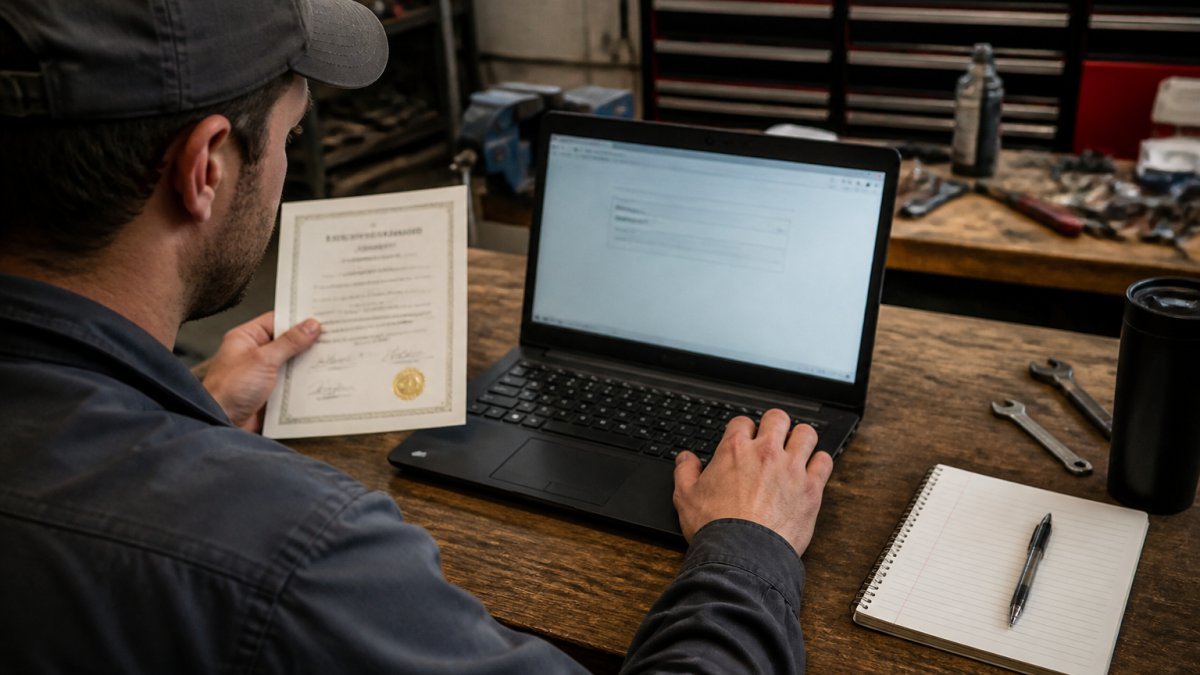
If you cannot find the right authority, search the trade name plus “apprenticeship authority” and the province or territory. Government sites are the only ones that should be trusted for the actual lookup; third-party directories are not authoritative.
AMVIC Inspection Mechanic Qualifications Explained
AMVIC sets the rules for vehicle inspections in Alberta. Mechanics who perform AMVIC inspections must meet specific qualification standards.
Those standards include holding a valid trade certificate and completing approved training.
If you’re buying a used vehicle, ask whether the inspection was done by an AMVIC-qualified mechanic.
For more on what these inspections cover, see AMVIC’s vehicle inspection program.
Distinguishing Mechanic Trade Credentials and Endorsements
Most verification mistakes happen because people treat four different things as if they were the same. They are not interchangeable, and each one answers a different question.
Certificate of Qualification
A certificate of qualification is the formal credential that says a person has met the requirements for a specific trade and passed the certification exam. It is issued by a province or territory. It answers the question: is this person certified in this trade? It does not, by itself, authorize every type of work. Some tasks, such as regulated vehicle inspections, require additional qualification on top of the certificate.
Journeyperson Status
“Journeyperson” is the title that goes with holding a certificate of qualification in most trades. It is not a separate credential you look up on its own; it is the status that the certificate confers. If a register shows a valid certificate of qualification, the person is a journeyperson in that trade. If the register shows only apprentice registration, they are not yet a journeyperson, regardless of how many years they have worked.
Apprentice Registration
An apprentice is someone in a structured training program under supervision. Their registration appears in the same public register as certified tradespeople, but the status field will say registered apprentice rather than certified. An apprentice can perform many tasks, but the trade’s rules require a certified journeyperson to supervise the work. If you are hiring for unsupervised work, apprentice registration is not sufficient on its own.
Red Seal Endorsement
A Red Seal endorsement is added to a provincial or territorial certificate of qualification when the tradesperson passes the interprovincial Red Seal exam (Red Seal Program). It signals that the credential meets a common national standard and makes it easier to have the certificate recognized in another province or territory. It does not replace the provincial certificate, and it does not by itself authorize work in a trade the person is not certified in.
Trade-Specific Endorsements and Authorizations
Some work requires an endorsement or authorization beyond the base certificate. Examples include:
- Regulated vehicle inspections: in some provinces, only mechanics who hold a specific inspection authorization can legally sign off on a safety or mechanical inspection. In Alberta, that authorization is tied to AMVIC’s requirements for inspection mechanics.
- Specialty endorsements: compressed natural gas, electric vehicle high-voltage systems, and similar specialties often require additional training and, in some cases, a separate endorsement on the certificate.
- Heavy equipment and commercial vehicle trades: these are separate trade designations from automotive service technician, with their own certificates and exams.
Why the Distinction Matters in Practice
A mechanic may hold a valid automotive service technician certificate, a Red Seal endorsement, and an inspection authorization, or any combination of the three. When you verify, match the credential to the work:
- General repair: certificate of qualification in the relevant trade is the baseline.
- Regulated inspection: confirm the inspection authorization, not just the trade certificate.
- Cross-province work: confirm the certificate is recognized in the province where the work is being done, and check whether a Red Seal endorsement is present.
A valid certificate of qualification confirms certification status in a specific trade and jurisdiction. It does not confirm experience level, current employment, or quality of work. Treat verification as one input, not the whole decision.
What to Do When a Search Returns No Match or Conflicting Details
A missing record doesn’t always mean fraud. It often means a data entry mismatch.
Try these fixes:
- Check the spelling of the name
- Try the certificate number instead of the name
- Confirm the issuing jurisdiction
If the details still conflict, ask the mechanic to show their physical certificate. A legitimate tradesperson will have no problem providing it.
Never accept a screenshot or photocopy as proof on its own. Screenshots are easy to fake. Always cross-check against the official online lookup tool.
Credential Verification vs Assessing Work Quality
A valid certificate proves someone passed the required exams and met training standards. It does not guarantee every job will be flawless.
Credential verification confirms qualifications. Work quality assessment is a separate step.
Both matter. A certified mechanic with poor reviews is still a risk.
This is where our approach at Vehicleinspectionservices helps. Our journeyman-certified mechanics bring verified credentials to every job.
Privacy, Consent, and Using Public Registers Responsibly
Public registers exist to protect consumers and employers. They are not tools for harassment or snooping.
Follow these rules:
- Use the lookup only for legitimate verification
- Don’t share a mechanic’s personal details publicly
- Respect that some records show limited information by law
Canada’s privacy laws govern how personal information in public registers can be used. For guidance on your obligations, see the Office of the Privacy Commissioner of Canada.
Using these tools responsibly keeps them available for everyone who needs them.
Building Credential Checks Into Your Routine
Verification shouldn’t be a one-time task. Make it a habit.
- Check credentials before hiring any tradesperson
- Re-verify when a certificate is close to expiring
- Keep a record of your checks for employers and fleet managers
A simple checklist keeps you consistent:
- Confirm the trade designation matches the work
- Search the provincial lookup tool by name or certificate number
- Verify certification status is active
That five-step routine takes minutes and prevents expensive mistakes.
Finding a mechanic you can trust starts with knowing how to verify journeyman mechanic credentials. At Vehicleinspectionservices, every mechanic on our team holds journeyman certification, and we bring that expertise directly to your location across Alberta. Our on-site service saves you a trip to the shop, and our complimentary Courtesy Check gives you added confidence before you commit.
Frequently Asked Questions
How do I verify a journeyman mechanic’s credentials in Alberta?
Start by asking the mechanic for their full name and certificate number. Then use Alberta’s public tradesperson lookup tool to search for their certificate of qualification. The record will show their trade designation, credential status, and issuing authority. If they hold a Red Seal endorsement, that should appear on the same record. Cross-check the name on the certificate against their photo ID to confirm you are looking at the right person.
Are AMVIC approval and journeyman mechanic certification the same thing?
No. AMVIC approval means a business is licensed to operate as an automotive business in Alberta and can perform provincially mandated inspections. Journeyman certification is a separate trade credential issued through Alberta’s apprenticeship system. A mechanic can hold one without the other. When booking an AMVIC inspection, confirm both that the shop is AMVIC-licensed and that the individual mechanic holds a valid certificate of qualification for the relevant trade.
What should I do if I cannot find a mechanic in the tradesperson lookup?
First, double-check the spelling of the name and the certificate number. Try searching by certificate number alone if the name search fails. If the record still does not appear, ask the mechanic directly for their certificate details and confirm which jurisdiction issued it. Some credentials from other provinces may not appear in Alberta’s register. If the person cannot provide verifiable documentation, treat that as a red flag and consider another service provider.
Does a journeyman mechanic need an Alberta trade certificate to work in the province?
Compulsory trades require certification to work legally in Alberta. Automotive service technician is a compulsory trade, meaning anyone performing those tasks must hold a valid certificate of qualification or be a registered apprentice. Out-of-province mechanics may hold an equivalent credential from their home jurisdiction, but they should be able to show proof of that credential and confirm whether it has been recognized in Alberta.