
Table of Contents
- How to Find a Mobile Mechanic in Edmonton: Step-by-Step
- Why an AMVIC Licensed Mobile Mechanic Matters
- What a Mobile Car Inspection Cost Actually Covers
- Mobile Mechanic vs Traditional Shop: Which Fits Your Week?
- Preparation Checklist Before Your Mobile Mechanic Arrives
- Seasonal Maintenance for Edmonton Winters and Summers
- Frequently Asked Questions
Last Updated: October 4, 2026
How to Find a Mobile Mechanic in Edmonton: Step-by-Step
Learning how to find mobile mechanic in Edmonton service starts with one hard rule: confirm the licence before you confirm the appointment. At Vehicleinspectionservices, our journeyman-certified mechanics have spent a decade doing exactly that.
The three steps below take about ten minutes and separate a legitimate on-site auto repair provider from someone with a toolbox and a truck.
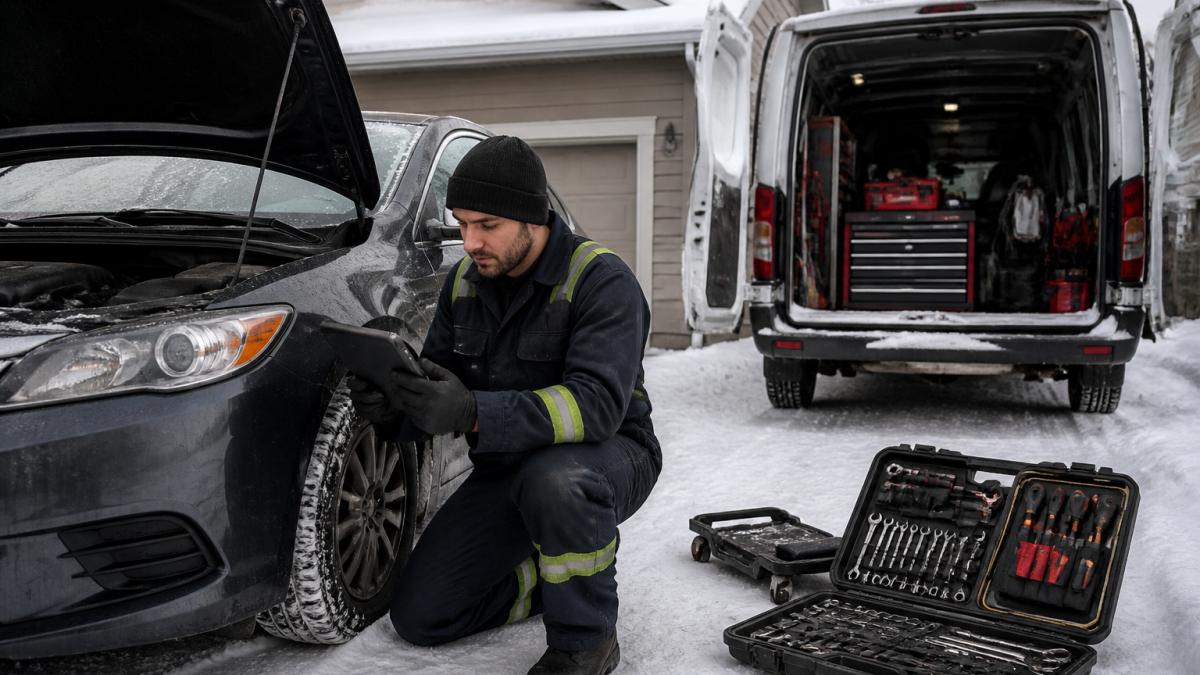
Step 1: Confirm the Shop’s AMVIC Licence
Ask for the business licence number before anything else. AMVIC is Alberta’s automotive business regulator, and any company selling automotive repair or inspection services in the province needs a current licence (Automotive repair activities). You can look up a licence yourself through AMVIC’s consumer licence search in about two minutes. No licence number, no booking.
Step 2: Check Insurance and Service Warranty
A licensed business should carry liability coverage and stand behind its parts and labor. Ask two direct questions: what happens if a repair fails, and who pays if a technician damages your property on site. Get both answers in writing before the service call.
Step 3: Match the Mechanic to the Job
Not every job suits a mobile setup. Battery replacement, brake service, engine diagnostics, and general automotive troubleshooting travel well. A transmission rebuild does not. Tell the dispatcher your make, model, year, and symptoms, then let them confirm whether the work fits an on-demand repair visit.
| Job Type | Fits Mobile Service? | Why |
|---|---|---|
| Battery replacement | Yes | Hand tools and a power source |
| Brake service | Yes | Standard parts, no lift required |
| Engine diagnostics | Yes | Portable scan tools |
| Preventative maintenance | Yes | Oil, filters, fluids |
| Transmission rebuild | No | Needs a shop bay and lift |
| Frame or body work | No | Specialized equipment |
Why an AMVIC Licensed Mobile Mechanic Matters
An AMVIC licence is your only real proof that the person working on your car answers to a regulator. Without it, you have no complaints process, no inspection trail, and no recourse if a repair goes wrong.
The licence also ties the business to standards for written estimates, parts disclosure, and record keeping, the records that protect you when something goes sideways.
How to Verify a Licence in Two Minutes
Go to AMVIC’s public licence search, enter the business name or licence number, and confirm three things: the licence is active, the business name matches your quote, and the licence covers the work you’re booking. If the number doesn’t appear, walk away.
Booking an unlicensed mechanic voids your ability to file a complaint with Alberta’s regulator. If a repair fails or damages your vehicle, you’re left negotiating privately with no oversight and no paper trail.
What a Mobile Car Inspection Cost Actually Covers
Mobile car inspection cost depends on the inspection type, the vehicle, and how far the technician travels. A pre-purchase inspection on a half-ton truck in a rural location is a different job than a quick courtesy check in the city.
What the Fee Should Include
A proper inspection covers a full vehicle inspection report, a diagnostic scan, a road test where conditions allow, and a written summary of defects ranked by urgency, plus the technician’s time and travel. Ask for the full scope in writing before you book, and check our site for current pricing.
The Four Things That Move the Price
- Inspection type. A pre-purchase inspection is the most thorough and costs the most. An insurance or safety inspection follows a defined checklist. A courtesy check is the lightest and cheapest.
- Vehicle class. A compact car inspects faster than a half-ton truck, a van, or a vehicle with a lift kit.
- Travel distance. A city driveway is a short drive; a rural property or acreage adds travel time the provider must recover.
- Condition and access. A clean vehicle that starts easily on level ground inspects faster than one caked in mud, won’t start, or sits tight against a fence.
Liability and Insurance: The Question to Ask Before Anyone Touches Your Car
When a mobile mechanic works in your driveway, two risks exist: damage to your vehicle and damage to your property (a cracked driveway, spilled fluid, a broken garage door). Before you book, confirm in writing:
- The business carries liability insurance and can provide a certificate of insurance on request
- Who pays if the technician damages your vehicle during the repair, the business’s insurance, or you?
- Who pays if your property is damaged, for example, if a jack slips or fluid stains your driveway
A licensed business should answer all four without hesitation. If a provider can’t produce proof of insurance or won’t put answers in writing, look elsewhere, an unlicensed or uninsured operator leaves you absorbing any damage with no regulator to escalate to.
Verbal assurances aren’t coverage. Ask for the certificate of insurance and the warranty terms in writing before the appointment. If a provider resists, treat that as a red flag, not a paperwork delay.
How to Compare Quotes Fairly
Ask every provider for the same three numbers: the base inspection fee, the travel charge, and whether a written report is included. Compare the total, not the headline rate.
Ask whether the quote includes travel time and a written report. Some providers advertise a low base rate, then add travel and reporting as separate line items. The number you compare should be the total.
Getting the Most From the Fee
A few habits stretch every inspection dollar:
- Book the inspection before you buy, a pre-purchase inspection is the cheapest insurance you’ll ever buy on a used vehicle
- Have registration, insurance, and service records ready so the technician spends time inspecting, not waiting
- Note symptoms and warning lights in advance so the diagnostic scan targets the right systems
Mobile Mechanic vs Traditional Shop: Which Fits Your Week?
The real question isn’t which option is better, it’s which costs less once you count everything. Most owners compare the mobile service call fee against a shop’s labor rate and stop there, which is why people overpay for mobile work that belongs in a bay or waste a day driving to a shop for a job that could have come to them.
The Full Cost Comparison Nobody Runs
When you price a repair, add these four lines on both sides:
- The service call or travel fee (mobile only) versus the cost of getting the vehicle to the shop, fuel, transit, a rideshare, or a tow if it won’t start
- Lost time, a shop visit typically consumes half a day; mobile work happens while you’re at home or at your desk
- Diagnostic fees, many shops charge a standalone fee credited only if you approve the repair; mobile providers often fold the scan into the visit
Mobile wins clearly on jobs under about two hours of labor; the shop wins once the job needs a lift, a bay, or a second day.
DIY vs. Professional Mobile Mechanic: When It Actually Pays to Call Someone
Before you book anyone, ask whether the job is genuinely DIY-able for your skill level and tool set.
DIY makes sense when:
- The job is a direct swap with no diagnostic uncertainty, wiper blades, cabin and engine air filters, a headlight or taillight bulb, a top-up of washer fluid or coolant
- You already own the tools (a socket set, a torque wrench, jack stands) and have a safe, level place to work
- A mistake won’t strand you or damage a costly component
Call a professional when:
- Diagnosis is the hard part, not the repair. A warning light, an intermittent no-start, or a noise that only appears at certain speeds needs a scan tool and experience to interpret
- The job touches brakes, fuel, airbags, or high-voltage systems, these carry real safety and liability exposure
- You’d need to buy a specialty tool you’ll use once. The tool cost alone often exceeds the labor you’re trying to avoid
The honest cost-benefit: DIY saves labor but costs time, tool purchases, and the risk of a misdiagnosis that leads to buying the wrong part. A mobile mechanic charges for labor but removes the guesswork, tool cost, and trip. For simple swaps, DIY usually wins; for anything diagnostic or safety-related, the professional visit is cheaper once you price in the downside.
Side-by-Side: What Each Option Is Actually Good At
- Time: Mobile service saves the drop-off, wait, and pickup. A shop visit can eat half a day even for routine work.
- Location: Mobile mechanics come to your driveway, office, or roadside. Shops require you to get the vehicle there, which matters most when it won’t start.
- Job fit: Battery replacement, brake repair, and diagnostics suit mobile. Major mechanical failure, frame work, and alignment-rack jobs usually don’t.
A Quick Decision Rule
If the vehicle starts, the job is routine, and you have a safe place to park it, mobile is usually the faster, cheaper total. If it won’t start, the job needs a lift, or the symptom is unclear, start with a diagnostic visit before committing to a repair. If you’re handy, tools-in-hand, and the job is a straight swap, DIY still beats both on price.
Get the mobile quote and the shop quote as totals, not hourly rates. Ask each provider for the all-in number including travel, diagnostics, and parts. Comparing an hourly rate to a flat service call is comparing two different things.
For busy professionals who travel for work, the mobile option often pays for itself in recovered time. For a vehicle that needs a lift and a week of work, book the shop.
Preparation Checklist Before Your Mobile Mechanic Arrives
A little prep turns a good service call into a great one. Use this checklist the day before:
- Clear driveway or parking access so the service van can park within reach of the vehicle
- Gather the registration, insurance, and any recent service records
- Write down symptoms in plain language, including when they started and what makes them worse
The single most useful prep step is a written symptom list. Technicians diagnose faster when they know when a noise appears, what speed triggers it, and whether it changes with temperature.
Seasonal Maintenance for Edmonton Winters and Summers
Edmonton’s temperature swings do more damage to vehicles than mileage does. Winters push the battery, block heater, and charging system to their limits; summers stress the cooling system, tires, and air conditioning.
Book preventative maintenance around the seasons rather than the calendar:
- Before winter: battery load test, block heater check, winter tire swap, coolant strength test
- Through winter: watch for slow cranking and dim lights, both early signs of a failing battery
- Before summer: cooling system flush, A/C check, tire pressure reset for heat expansion
Preventative care costs less than emergency repair every time, a battery that fails at -25°C is a tow, a lost day, and an unplanned replacement.
Finding a mobile mechanic in Edmonton shouldn’t feel like a gamble, and it doesn’t have to.
Frequently Asked Questions
How much does it cost to get a mobile mechanic out?
A mobile car inspection cost depends on the type of inspection, the vehicle’s make and model, and how far the mechanic travels. A pre-purchase inspection, an AMVIC inspection, and a general diagnostic visit are priced differently because they involve different checks and time on site. Mobile service often costs a little more than a shop visit because the mechanic brings the tools and equipment to you. Request a written repair estimate before you book so parts and labor are itemized clearly.
Are mobile mechanics in Edmonton required to be AMVIC licensed?
Yes. Anyone performing automotive repair for pay in Alberta must hold an AMVIC licence, and that includes mobile mechanics who come to your home or workplace. AMVIC is the provincial regulator for the automotive industry, so a legitimate operator will have a licence number you can confirm through AMVIC before any work begins. An AMVIC licensed mobile mechanic can also issue the inspection reports some sellers and insurers require.
What are the drawbacks of using a mobile mechanic?
The main limits are the scope of work and the working conditions. A mobile mechanic can handle diagnostics, brake service, battery replacement, and preventative maintenance in most driveways, but jobs that need a hoist, a wheel alignment rack, or a climate-controlled bay still belong in a shop. Weather and parking access can also slow things down. Ask upfront whether your specific repair can be completed on site or needs to be referred.
How do I verify the credentials of a mobile mechanic?
Ask for the AMVIC licence number and the technician’s journeyman certification, then confirm both directly with AMVIC and the issuing authority rather than relying on a website badge. Also request proof of liability insurance. A reputable operator will send this information without hesitation before you commit to a service call.