
Table of Contents
- What a Mobile Mechanic Warranty Typically Covers
- AMVIC Licensed Mobile Mechanic: What It Means for Your Warranty
- Mobile Mechanic vs Auto Repair Shop Warranty: Key Differences
- What to Include in a Written Repair Invoice for Warranty Claims
- How to Make a Warranty Claim After a Mobile Repair
- Common Limitations and What to Ask Before You Book
- Frequently Asked Questions
Last Updated: September 16, 2026
What a Mobile Mechanic Warranty Typically Covers
A mobile mechanics warranty is a written promise from the service provider to correct defects in parts or workmanship if a covered repair fails within a set period. Most legitimate providers back their work, but the scope of that promise varies widely. At Vehicleinspectionservices, our journeyman-certified mechanics work across Alberta, and this guide breaks down what a mobile mechanic warranty actually covers and what it does not.
Parts vs. Labor: What Gets Covered
Parts coverage protects you if a component the mechanic installed fails prematurely. Labor coverage protects you if the installation itself was faulty, such as a loose fitting or an incorrectly torqued bolt.
AMVIC Licensed Mobile Mechanic: What It Means for Your Warranty
An AMVIC licensed mobile mechanic operates under the Alberta Motor Vehicle Industry Council’s regulatory framework, which sets standards for automotive businesses in the province. Licensing does not automatically create a warranty, but it does give you a formal channel for complaints if a business fails to honor its commitments.
Ask for the AMVIC registration number and the mechanic’s journeyman certification before the appointment, not after. A legitimate provider will share both without hesitation. If they deflect or promise to “send it later,” treat that as a warning sign.
Mobile Mechanic vs Auto Repair Shop Warranty: Key Differences
A mobile mechanics warranty and a traditional shop warranty cover similar ground but differ in how claims are handled. The core coverage, parts and labor against defects, is comparable. The logistics are not.
| Factor | Mobile Mechanic | Traditional Shop |
|---|---|---|
| Warranty period | Often shorter, varies by provider | Typically longer, standardized |
| Claim process | Return visit to your location | You drive back to the shop |
| Documentation | Service invoice, sometimes digital | Printed invoice, shop records |
| Recourse | AMVIC, if licensed | AMVIC, if licensed |
| Convenience | High, they come to you | Lower, you travel to them |
A common mistake is assuming a mobile provider’s warranty matches a dealership’s. It usually doesn’t. Dealership warranties are often backed by the manufacturer; mobile provider warranties are backed by the business itself. If that business closes, your warranty may be worthless. Choose established providers with a track record.
What to Include in a Written Repair Invoice for Warranty Claims
A written repair invoice is your primary evidence if you need to make a warranty claim. Without one, proving what was done, when, and by whom becomes difficult. Insist on a detailed invoice every time.
A warranty-ready invoice should include:
- Business name, AMVIC registration number, and contact details
- Date of service and the vehicle’s mileage at the time
- Itemized parts used, including whether they are new, reconditioned, or aftermarket
- Labor performed, with the labor rate and hours billed
- The warranty terms: duration, what’s covered, and what voids coverage
- A clear description of the diagnostic findings and the repair authorization
How to Make a Warranty Claim After a Mobile Repair
Making a warranty claim after a mobile repair follows a predictable sequence, but the logistics differ from a shop because the mechanic has to come back to you. Move quickly, document everything, and keep the communication in writing.
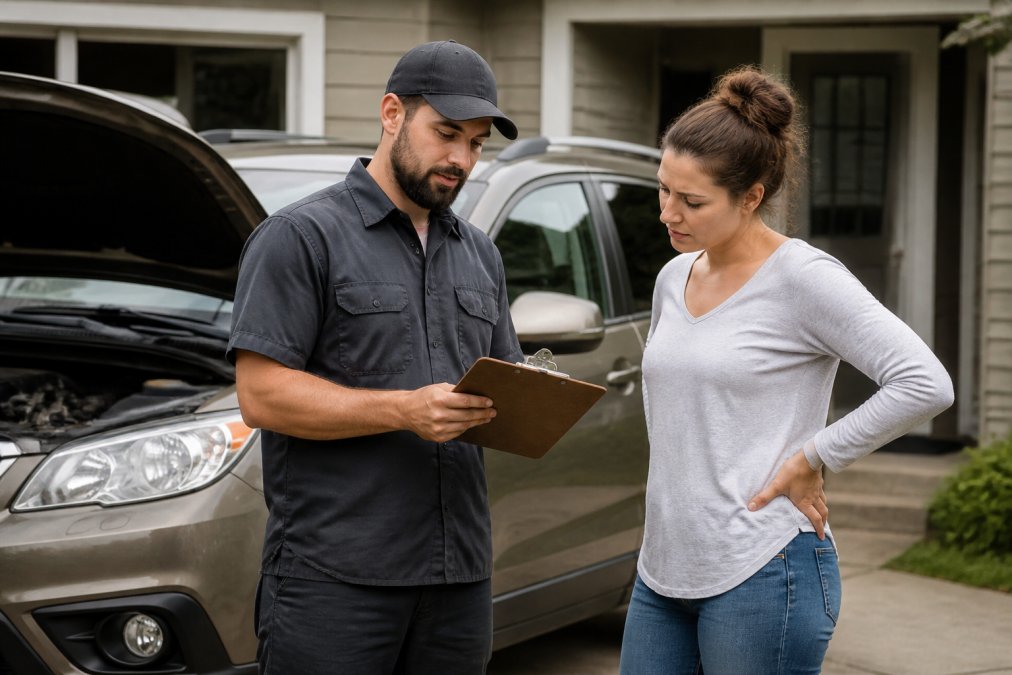
- Identify the failure. Confirm the problem relates to the original repair, not a separate issue. A new noise after a brake job is likely covered; a dead battery is not. Note the date, mileage, and exact symptom.
- Stop driving if it’s a safety concern. Brakes, steering, and suspension failures should not be driven on. Park the vehicle and call the provider.
- Contact the provider in writing. Email or text creates a record. State the date of the original repair, the invoice number, the mileage, and the symptom. Avoid phone-only conversations for the initial claim.
- Send the documentation packet. Attach the original invoice, photos or video of the failure, and any diagnostic codes if you have a scan tool or a parts store read them for you.
- Request a return visit and confirm the terms. Ask three specific questions: Is the diagnostic fee waived for a warranty claim? What is the expected response window? Will the follow-up repair be documented on a new invoice that references the original?
- Get the follow-up repair documented. The second invoice should reference the original invoice number and confirm the work was done under warranty at no charge (or state the parts-only charge if labor is not covered).
The documentation packet that makes a claim enforceable
Most denied claims fail on paperwork, not on the merits. Before you ever need to file, build a single folder, physical or cloud, that contains:
- The original invoice with the AMVIC registration number, mileage, parts list, and warranty terms
- Photos of the failed component and the surrounding area
- A short written timeline: date of repair, date the symptom appeared, dates of all communications
- Copies of every email or text with the provider
- The provider’s warranty policy document, if one was supplied
If the provider stalls or refuses
Escalate in writing first. Send a single email that restates the facts, attaches the packet, and gives a reasonable deadline for a response. If that fails, a licensed provider can be reported to AMVIC, which regulates automotive repair businesses in the province. Keep every message; a clean paper trail is what turns a dispute into a resolution.
Third-party and aftermarket warranty providers
If you bought an extended warranty or aftermarket service contract, the mobile mechanic is usually not the warranty provider, the contract company is. In that case the mechanic is a repairer, not the guarantor. Before authorizing the repair, ask the contract company whether mobile service is covered, whether a pre-authorization number is required, and whether they will pay the mechanic directly or reimburse you.
The single most important thing you can do is document the original repair properly. A detailed invoice with the AMVIC number, mileage, parts used, and warranty terms turns a disputed claim into a straightforward one, and a pre-authorization number turns an aftermarket warranty into a payable one.
Common Limitations and What to Ask Before You Book
Most warranty disputes trace back to limitations the customer never read. Understanding the mechanism behind each one, not just the label, is what prevents surprises.
How warranty scope varies by repair type
Not all repairs carry the same warranty, even from the same provider. A useful rule of thumb:
- Routine maintenance (oil changes, tire rotations, wiper replacement) is often covered only for workmanship, and only for a short window, commonly 30 days or until the next scheduled service.
- Brake and suspension work typically carries a labor warranty in the 90-day to one-year range, with parts covered by the parts manufacturer rather than the mechanic.
- Complex engine and transmission work usually carries the longest labor warranty, sometimes 12 months or more, because the provider’s exposure is higher and the diagnostic investment is larger.
- Electrical and diagnostic-only visits are frequently excluded from warranty entirely, because the outcome depends on intermittent faults the mechanic cannot reproduce.
Common limitations and why they exist
- Time-based windows that expire, often 30 to 90 days. The clock usually starts on the service date, not the date you notice the problem.
- Mileage caps, such as coverage voided after a set distance. This protects the provider from wear-and-tear claims on a vehicle driven far beyond normal use.
- Unrelated-failure exclusions, meaning only the specific repaired component is covered. A failed alternator does not reopen a brake job.
- Voided coverage if another shop touches the repair. This is the most common trap: a second opinion or a quick top-up elsewhere can end your warranty.
- Reconditioned or aftermarket parts carrying shorter or no warranty compared to new OEM parts. Confirm which category was installed.
- Diagnostic fees charged even on valid claims. Some providers waive them; many do not. Get the answer before you book.
- Consequential damage exclusions, meaning the provider covers the failed part but not the damage it caused to other components.
What to ask before you book
- What’s the warranty period for this specific repair, and does it run from the service date or the mileage?
- Does it cover parts, labor, or both?
- What voids the warranty, and will a second opinion void it?
- Is there a diagnostic fee for warranty claims?
- Are the parts new, reconditioned, or aftermarket, and what warranty does each carry?
- Will you provide a written invoice with the AMVIC number and warranty terms?
Get the answers in writing before the mechanic starts work. A provider who won’t commit to terms in writing is telling you something important.
Vehicle owners who want on-site service without sacrificing accountability. A provider that issues detailed written invoices and holds AMVIC registration gives you both convenience and recourse.
Frequently Asked Questions
Do mobile mechanics guarantee their work?
Most mobile mechanics offer some form of workmanship guarantee, but coverage varies widely. A typical warranty covers the labor for a set period, often 90 days to 12 months, and may include parts if the mechanic supplied them. The key is getting the warranty terms in writing before work begins. Ask specifically what is covered, how long the warranty lasts, and what process to follow if something fails. Without a written warranty, your options are limited to whatever consumer protection rules apply in your province.
How do I verify if a mobile mechanic is AMVIC licensed?
AMVIC licenses automotive businesses in Alberta, including mobile mechanics who perform regulated work. To verify, ask for the mechanic’s AMVIC license number and check it directly on AMVIC’s online licensee search. A legitimate AMVIC licensed mobile mechanic will provide this without hesitation. Licensing confirms the business meets provincial standards for automotive repair, which strengthens your position if you need to make a warranty claim. Unlicensed operators may still do good work, but you have fewer protections if something goes wrong.
What are the common limitations of mobile mechanic warranties?
Mobile mechanic warranties often exclude wear-and-tear items like brake pads, belts, and filters. They may also limit coverage to the specific repair performed and not cover consequential damage to other components. Some warranties require you to use the same mechanic for follow-up work, and mileage or time limits apply. Third-party warranty companies may not recognize mobile repairs unless the mechanic is pre-approved. Always read the fine print and ask about exclusions before authorizing any repair work.
What happens if a repair fails after the mobile mechanic leaves?
If a repair fails within the warranty period, contact the mechanic immediately and describe the issue. Most reputable mobile mechanics will schedule a return visit to inspect and redo the work at no extra labor cost. Keep your written repair invoice and any photos or notes about the failure. If the mechanic is unresponsive, you can file a complaint with AMVIC if they are licensed. For urgent safety issues, do not drive the vehicle; arrange a tow or a second opinion from another shop.