
Table of Contents
- Start With a Used Car Pre-Purchase Inspection Checklist
- How to Check a Car for Frame Damage and Structural Repair
- Frame, Suspension and Alignment Clues That Signal Hidden Car Damage
- Signs of Poor Car Body Repairs: Paint, Bumpers and Trim
- Fluid Leaks, Electrical Faults and Under-Hood Checks
- Vehicle History Report Limitations and Repair-Record Verification
- Test-Drive Checks That Reveal Hidden Car Damage
- When to Book an Independent Pre-Purchase Inspection
- Frequently Asked Questions
Last Updated: October 17, 2026
Start With a Used Car Pre-Purchase Inspection Checklist
Most buyers discover hidden car damage weeks after signing, when the first repair bill lands. This guide gives you a repeatable inspection sequence that spots concealed collision damage, structural repair, and mechanical faults before they become your problem.
A pre-purchase inspection is a structured check of a used vehicle’s body, frame, mechanical systems, and records, done before you commit to buying. It catches problems a short test drive never will.
What to Bring and How to Set Up the Inspection
- A strong flashlight or headlamp
- A small magnet (checks for body filler)
- A printed or digital checklist
Set up in daylight, on flat ground, with the engine cold, a cold engine reveals fluid leaks a warm one hides. Ask the seller not to start the car before you arrive.
The Walk-Around Sequence That Catches Most Problems
Work in a fixed order so you never skip a zone: front bumper, hood, both fenders, both doors, roof, trunk, rear bumper, then underneath.
Kneel at each corner and sight down the body line for ripples, uneven gaps, and mismatched paint. This walk-around catches most hidden damage before you open the hood.
A Step-by-Step Checklist You Can Actually Follow
Use this sequence in order. Each step has a clear pass/fail test.
- Records first, before you touch the car. Ask for the VIN, then compare it to the dash and door-jamb stickers. Request service invoices, body shop receipts, and any insurance claim paperwork. No records isn’t proof of hiding damage, but it means leaning harder on the physical inspection.
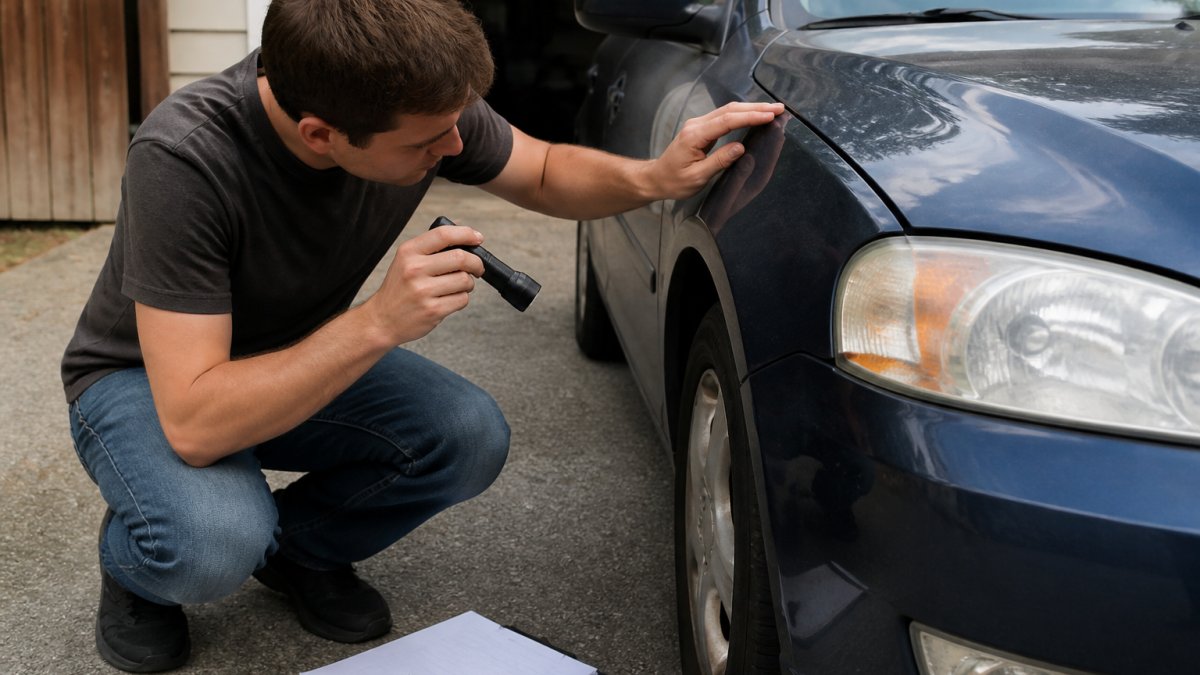
- Panel gaps and paint, in direct sunlight. Run a finger along every gap between doors, hood, fenders, and trunk; gaps should be even side to side. Sight down each panel from a low angle, a color shift or differing clearcoat texture suggests a repaint. Pass if gaps are even and paint matches; fail on ripples, tight gaps, or overspray.
- Magnet test on steel panels. Wrap a small magnet in cloth and drag it slowly across fenders, doors, and quarter panels. It should pull firmly and evenly; a weak or absent pull means body filler over dent repair. Pass if the pull is consistent; fail on a soft spot larger than a coin.
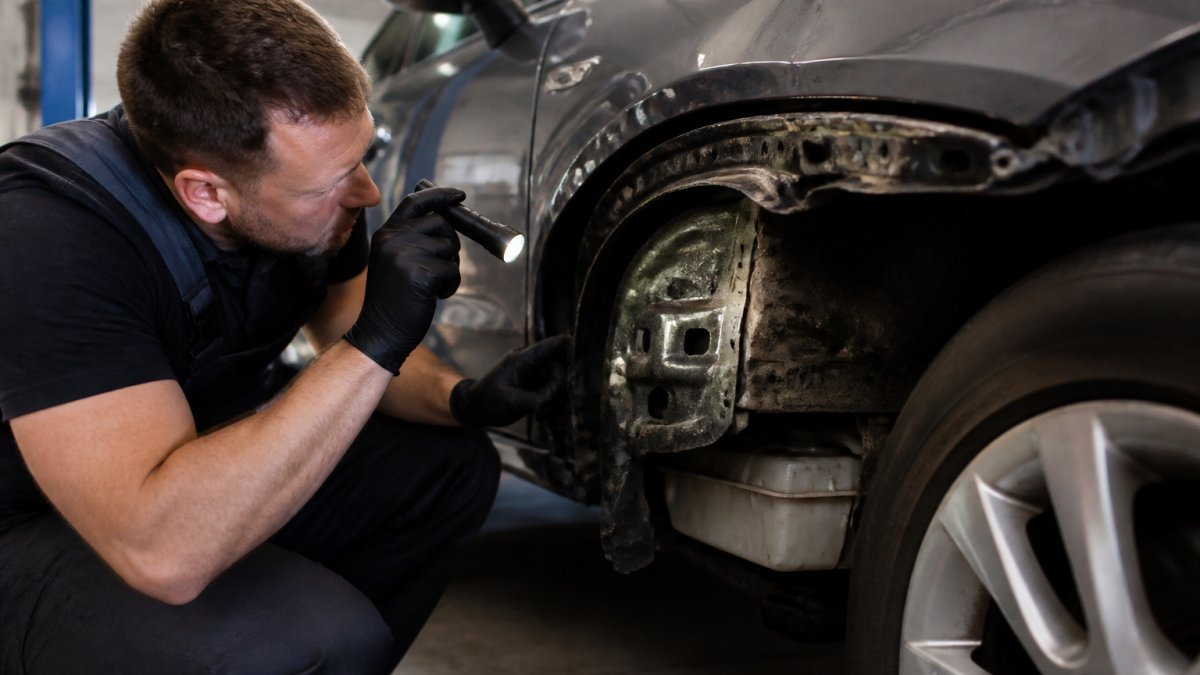
- Frame rails and crumple zones. Look at the front and rear frame rails for wrinkles, kinks, or fresh undercoating that doesn’t match the rest of the underside. Factory welds are even and painted; aftermarket welds look lumpy and often sit near fresh seam sealer. Pass if rails are straight and welds are factory; fail on any kink, fresh undercoat, or lumpy weld.
- Suspension and tire wear. Check inner and outer tire edges for uneven wear. Push down on each corner; the car should settle once and stop. Pass if tires wear evenly and the car settles; fail on cupping, feathering, a single bald edge, or continued bouncing.
- Under-hood, engine cold. Look for dark oil, green or orange coolant residue, and pink transmission fluid. Check the ground beneath the car. Turn the key to accessory and confirm all warning lights illuminate, then go out once the engine starts. Pass if fluids are clean and lights behave; fail on fresh leaks or a warning light that never comes on.
- Diagnostic scan. Use a basic scan tool or a shop’s OBD reader to pull stored codes. Check that sensors, airbags, and safety systems show no stored faults. Pass if there are no stored codes; fail on any active or pending fault you cannot explain.
- Glass, seals, and weather stripping. Look for loose or glued-back seals, mismatched glass dates, and water stains in the trunk or footwells. Pass if seals sit flat and glass dates are consistent; fail on fresh sealant or water intrusion.
- Underneath, if you can safely see it. Look for fresh undercoating, bent exhaust hangers, and scrape marks that suggest a hard impact. Pass if the underside is consistent; fail on fresh undercoat or bent components.
- Test drive. Drive at least 15 minutes on mixed roads, including a safe stretch at highway speed. Watch for pulling, vibration, clunks, delayed shifting, and a burnt odor. Pass if the car tracks straight and shifts smoothly; fail on any symptom you cannot attribute to road surface.
Prioritize What You Find by Safety and Urgency
Not every finding is a deal-breaker. Sort what you find into three buckets before you negotiate.
- Walk away: frame or structural repair, airbag or restraint-system faults, brake faults, and steering binding. These are safety items that a cosmetic fix cannot undo.
- Negotiate or budget for repair: suspension wear, fluid leaks, and electrical faults that a shop can quote. Get a written estimate before you agree on a price.
- Cosmetic only: paint mismatch, trim damage, and minor rust. These are negotiating points, not reasons to walk.
Buyers often fixate on cosmetic flaws and miss a bent frame rail. Work the checklist in order and let the safety items decide the deal.
Photograph every finding as you go. A dated photo of a bent frame rail or a fresh weld is far more useful in negotiation than a verbal description, and it gives a professional inspector a head start.
How to Check a Car for Frame Damage and Structural Repair
Frame damage is the deal-breaker. A bent or repaired frame affects how the car absorbs impact and can’t be undone with a cosmetic fix. Frame damage means the structural skeleton has been bent, cracked, or repaired after a collision, which weakens crash protection and often totals the car’s value.
Panel Gaps, Crumple Zones and Weld Signs
Check these four areas closely:
- Panel gaps: run a finger along the gaps between doors, hood, and fenders. Uneven or tight gaps suggest a bent structure.
- Crumple zones: look at the front and rear frame rails for wrinkles, kinks, or fresh undercoating.
- Weld signs: factory welds are even and painted. Aftermarket welds look lumpy and often sit near fresh seam sealer.
If any of these look off, walk away or book a professional inspection before negotiating.
Frame, Suspension and Alignment Clues That Signal Hidden Car Damage
Suspension problems often hide behind a smooth ride. Suspension damage shows up as bent control arms, worn bushings, or a car that pulls to one side.
Push down on each corner; it should settle once and stop. Continued bouncing means worn shocks or struts.
Cupping, feathering, or a single bald edge on the tires all tell a story about alignment and steering health.
A car that recently had an alignment done may be masking bent suspension parts. Ask for the alignment printout and check whether it shows a correction, not just a fresh setting.
Signs of Poor Car Body Repairs: Paint, Bumpers and Trim
Cosmetic repairs hide the worst secrets. Paint mismatch between adjacent panels is the classic tell, look in direct sunlight and from a low angle, where color differences show clearly.
Other red flags:
- Overspray on window trim, rubber seals, or the wheel wells
- Bumper cover that sits unevenly or has a different texture than the body
- Internal bumper components you can see through gaps, showing crush damage behind a fresh cover
Run a magnet wrapped in cloth over body panels. It sticks to steel but not to filler. A weak pull means bodywork underneath.
Fluid Leaks, Electrical Faults and Under-Hood Checks
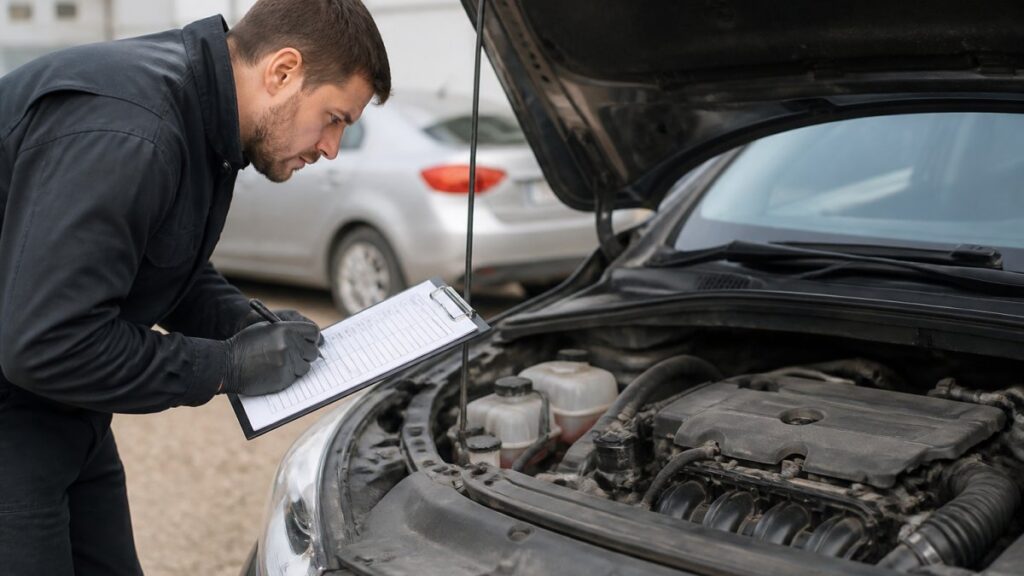
Pop the hood with the engine cold. Look for fluid leaks first: dark oil spots, green or orange coolant residue, and pink transmission fluid.
Electrical problems are harder to spot by eye. Turn the key to accessory and watch the dash: all warning lights should illuminate, then go out once the engine starts.
Ask for a diagnostic scan to pull stored codes. A basic scan tool or a shop’s OBD reader reveals faults the seller may not mention.
Vehicle History Report Limitations and Repair-Record Verification
A vehicle history report is useful, but not a guarantee. Reports only capture what was reported; damage fixed privately, or a collision that never went through insurance, often leaves no trace.
Verify records directly:
- Ask for service invoices and body shop receipts
- Match repair dates to the accident history and any insurance claim
- Confirm the VIN on the report matches the car’s dash and door jamb
Cross-check the seller’s story against the paperwork. Gaps between what they say and what the records show are a reason to slow down.
Test-Drive Checks That Reveal Hidden Car Damage
A test drive is a diagnostic tool, not a joyride. Drive at least 15 minutes on mixed roads, including a stretch where you can safely reach highway speed.
Watch for:
- Pulling to one side or a crooked steering wheel
- Vibration through the seat or wheel at speed
- Clunks or knocking over bumps
Test the brakes firmly in a safe spot. Listen for grinding or squealing. Try a slow, tight turn in a parking lot to check for binding or noise. Any of these symptoms deserves a professional look before you buy.
When to Book an Independent Pre-Purchase Inspection
Book a professional inspection whenever the stakes are high: an expensive vehicle, a private sale with thin records, or any car that showed warning signs during your own checks. A visual check and a scan tool have limits. A lift, a trained eye, and proper diagnostic equipment catch what a driveway inspection cannot.
What a Professional Inspection Adds That You Cannot Do Yourself
A driveway inspection is a screening tool. A professional inspection is a measurement tool. The difference is equipment and access.
- A lift. Raising the car reveals frame rails, subframe mounts, exhaust hangers, and underbody corrosion you cannot see lying on your back, plus bent suspension components and fresh undercoating hiding repair.
- Measurement equipment. Frame straightening leaves traces only a measuring system or a trained eye on a lift will catch. Panel gaps can be adjusted cosmetically; frame dimensions cannot.
- A full diagnostic scan. A basic OBD reader pulls engine codes; a professional scan tool reads body control, airbag, ABS, and transmission modules, and can show stored faults a seller cleared from the dash but not from memory.
What the Inspector Should Check
Ask what the inspection covers before you book. A thorough pre-purchase inspection should include:
- Body and frame: panel gaps, paint, welds, frame rails, and underbody condition on a lift
- Mechanical: engine, transmission, brakes, steering, suspension, and exhaust
- Fluids: leaks, condition, and levels
How to Choose and Brief an Independent Inspector
Independence matters. An inspector who also sells repair work has an incentive to find problems; one who works for the seller has an incentive to miss them. Choose a mechanic or body shop with no relationship to the seller.
Brief the inspector on what you already found and share your photos and notes; a good inspector will focus on the areas you flagged.
When to Walk Away Before Spending on an Inspection
Some findings are clear enough that an inspection is a waste of money. If you see a bent frame rail, fresh welds near a crumple zone, or an airbag warning light that stays on, walk away. An inspection confirms doubts; it does not resurrect a car with structural damage.
A vehicle history report is not a substitute for an inspection. Reports only capture what was reported, and damage fixed privately often leaves no trace. Use the report to cross-check the seller’s story, then use the inspection to check the car itself.
This is where Vehicleinspectionservices helps. Our journeyman-certified mechanics come to your location, whether you’re in a city or two hours out. We provide pre-purchase, insurance, and AMVIC inspections.
Book the inspection before you agree on a price, and ask the seller to meet you at the vehicle’s location. An on-site inspection keeps the process simple and gives you a written record to negotiate with.
Frequently Asked Questions
How can you tell if a used car has hidden damage?
Look for uneven panel gaps, paint mismatch, overspray on trim or glass, and a hood, trunk or door that does not sit flush. Check tire wear across the tread for uneven patterns, look for fresh undercoating over rust, and sniff for burnt odor or coolant smell under the hood. A diagnostic scan and a test drive at highway speed add clues a visual check misses. If anything looks off, arrange an independent pre-purchase inspection before you commit.
Can a vehicle history report reveal all past damage?
No. Reports only capture what was reported: insurance claims, some police records and certain service events. Repairs paid out of pocket, damage fixed privately or incidents in another jurisdiction often never appear. Use the report as a starting point, then verify with a physical inspection. Ask the seller for repair invoices and compare dates and mileage against the report. Gaps between records are a reason to look harder, not a clean bill of health.
How do you check a used car for frame damage?
Open the hood and trunk and inspect the inner fenders, apron and rail areas for wrinkled metal, fresh welds or mismatched seam sealer. Compare panel gaps on both sides of the car; a wider gap on one side suggests movement. Look at the crumple zones for buckling and check bolt heads on suspension components for tool marks. A four-wheel alignment reading and a lift inspection confirm what a visual check only hints at.
Should you get a professional inspection before buying a used car?
For any vehicle priced high enough to hurt if it fails, yes. A journeyman-certified mechanic with a lift and a diagnostic scan sees things a driveway check cannot: subframe condition, brake and suspension wear, stored fault codes and fluid condition. Mobile inspection services bring that check to the seller’s location, which helps when the car is far from home. Prioritize safety items first, then negotiate repair costs into the price.
Buying a used car shouldn’t feel like a gamble. Hidden car damage is real, but a disciplined inspection sequence exposes most of it before money changes hands. When you want certainty, Vehicleinspectionservices brings journeyman-certified mechanics to your location for pre-purchase, insurance, and AMVIC inspections, backed by a decade of service and a complimentary courtesy check. Contact us to book your inspection and buy with confidence.