
Quick Summary
To check used car history, find the car’s 17-character VIN on the dashboard, door jamb and documents, then order a vehicle history report and run a lien search. Look for salvage titles, accident damage and odometer inconsistencies before you pay. A clean report is not proof of a clean car, so always get a physical inspection too.
- Confirm the VIN matches on the dashboard, door jamb sticker and every document.
- A salvage or rebuilt title means an insurer once declared the car a total loss.
- Check that the odometer reading rises steadily across every recorded point.
- Run a lien search by VIN and get a payout letter before handing over money.
- A clean report does not replace a hands-on pre-purchase inspection.
Table of Contents
- Why Checking Used Car History Matters Before You Buy
- Find and Verify the Vehicle Identification Number (VIN)
- Order a Vehicle History Report and Know What It Covers
- Check Title Status, Accident Damage and Odometer Readings
- Run a Used Car Lien Check Before You Hand Over Money
- Reconcile Conflicting Records and Recognize Report Limits
- Use This Used Car Inspection Checklist and Book Your Pre-Purchase Inspection
- Frequently Asked Questions
Why Checking Used Car History Matters Before You Buy
Last Updated: November 14, 2026
Buying a used car without checking its history is a gamble.
A vehicle history report is a record of a car’s past. For a broader overview of how inspections fit into buying a used vehicle, see Demystifying Pre-Purchase Inspections: A Guide for Smart Vehicle Buyers.
Many buyers assume a clean-looking car has a clean past. That is often not true. Damage can be repaired cosmetically, and a car with a serious collision can look fine on the surface.
Here is what a history check helps you avoid:
- Buying a car with a salvage or rebuilt title you did not expect
- Taking on a loan the seller still owes on the vehicle
- Paying a price based on mileage that was rolled back
- Missing a theft record that could mean the car is not legally yours to sell
- Spending money on an inspection of a car that should have been rejected up front
Find and Verify the Vehicle Identification Number (VIN)
Every car has a unique 17-character vehicle identification number, or VIN. You need this number to run any history check.
You can find the VIN in a few places on the vehicle:
- On the dashboard, visible through the windshield on the driver’s side
- On the driver’s side door jamb sticker
- On the vehicle registration and insurance documents
- On the engine block or firewall stamp, on many models
Check that the VIN matches in all of these places. A mismatch can point to a stolen car, a cloned identity or a car that was rebuilt after a serious accident.
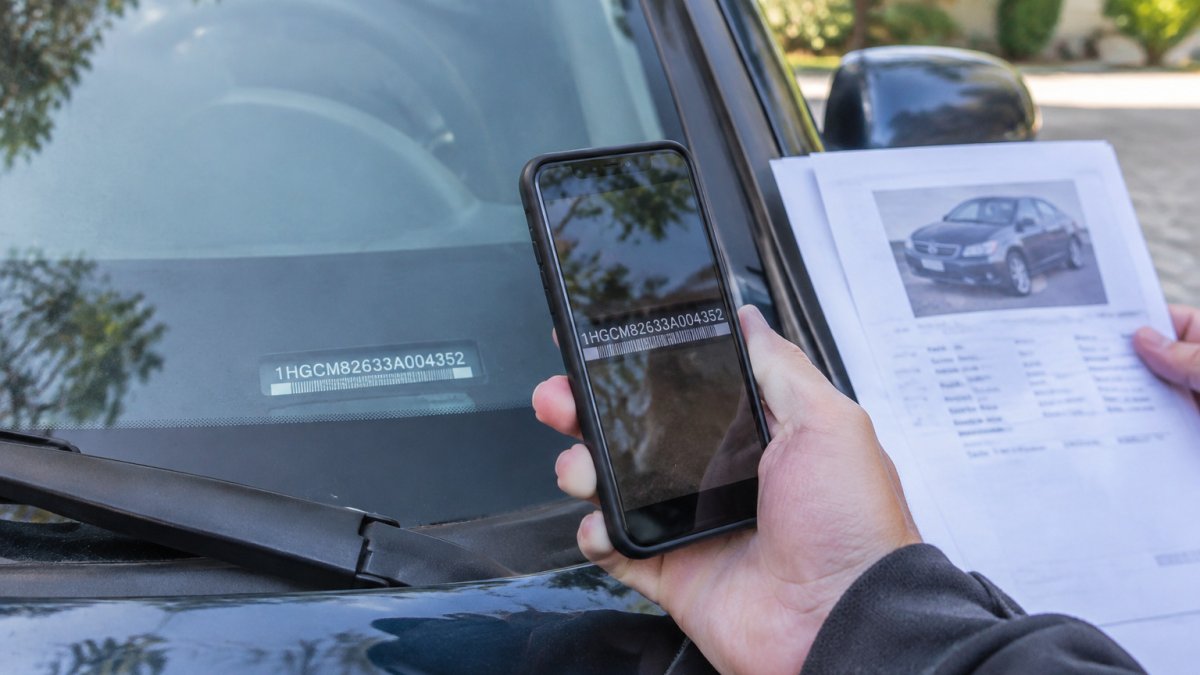
Decode the VIN before you trust it
A typical VIN has 17 characters and does not use the letters I, O or Q. The characters are not random.
Use a free VIN decoder to confirm the car matches its description. If the seller advertises a 2021 model but the tenth character decodes to an earlier year, treat that as a warning sign. If the VIN has the wrong length or contains an I, O or Q, it is not a valid VIN.
Compare the VIN across every document
A VIN check is only useful if you compare it everywhere it appears. Line up the VIN from the vehicle itself against:
- The registration and insurance documents
- The bill of sale or seller’s listing
- The vehicle history report you order
- Any service or repair invoices the seller provides
All of these should match. A single document with a different VIN is a red flag, even if the seller has a plausible explanation.
Watch out: Sellers sometimes give you a VIN from a different car or a partial number. Always read the VIN yourself from the vehicle, not only from the paperwork, and check the door jamb sticker and dashboard plate against each other before you run any report.
Spot signs of VIN tampering
VIN plates and stickers are sometimes swapped or altered to hide a stolen or rebuilt car. Look for a dashboard plate that is loose, riveted over the original, or covered in fresh paint.
If the VIN looks altered or you cannot reconcile it across the vehicle and the documents, stop. Do not pay for a report or an inspection until the VIN is confirmed.
Order a Vehicle History Report and Know What It Covers
A vehicle history report pulls data from different sources, including insurance claims, provincial records, auction records and service databases. Reports differ in what they cover and how much they cost, so know what you are buying before you pay.
Here is how the main options compare:
| Option | Typical Cost (CAD) | What It Covers | Best For |
|---|---|---|---|
| Paid report from a major provider | Check the provider’s current price | Accidents, title history, odometer, liens, theft | Full history on a serious purchase |
| Free government or registry checks | Usually no fee | Limited title and registration data | First-pass screening |
| Free VIN decoder tools | No fee | Vehicle specs and build details only | Confirming the car matches its description |
Prices for paid reports change, so check the provider’s website for the current cost.
How reports are built, and why that matters
A history report is a compilation, not an official record. Providers buy or license data from insurers, provincial registries, auctions, police and service shops, then match it to the VIN.
A common pattern is that collision damage repaired privately, without an insurance claim, never appears in any report. A car damaged in one province and repaired in another may show the claim in one jurisdiction but not the other.
Data delays and jurisdiction gaps
Records take time to appear. A claim filed recently may not show up right away. A recent sale or registration change may lag. If you are buying a car that changed hands or provinces recently, assume the report is incomplete for that period.
Jurisdiction matters too. Provincial registries hold title and registration data, but they do not all share the same fields or update at the same speed.
A clean report is not proof of a clean car
This is the most important limit to understand. A clean report means the provider found no negative records in its sources.
Treat the report as one piece of evidence. Use it to generate questions for the seller and to decide whether the car deserves a closer look.
Watch out: A clean report can create false confidence. If the report shows nothing, still get a physical inspection before you buy, and ask the seller directly about any gaps in the record.
Check Title Status, Accident Damage and Odometer Readings
The title tells you whether the car has been legally owned, written off or rebuilt. Look for these key points in the report:
- The current title status and the province that issued it
- Any salvage, rebuilt or write-off status
- The number of owners and how long each one kept the car
- The registration history, including any province changes
A salvage or rebuilt title is a major warning sign (Mandatory Vehicle Branding Program). It means an insurer once declared the car a total loss. Some rebuilt cars are safe, but they should be priced lower and inspected more closely.
Reviewing Accident and Damage History
Accident records show where and how hard the car was hit. Look for repeated claims, airbag deployment or frame damage. A single minor claim is common. Several claims in a short period suggest a bigger problem.
Compare the damage history with what you see on the car. Look for mismatched paint, uneven panel gaps or new welds under the hood.
Verifying Mileage and Odometer Readings
Odometer fraud is still a problem. A car with rolled-back mileage can cost you far more in repairs than the price you paid.
Check the mileage at each recorded point in the report. The odometer should go up over time. If the reading drops between two records, or if the number seems too low for the car’s age, ask the seller for an explanation. Look at service records too.
- Compare the report’s mileage with the reading on the dashboard
- Look for gaps in service history that make the mileage hard to trace
- Note any sudden drop in recorded kilometres between owners
Run a Used Car Lien Check Before You Hand Over Money
A lien means a lender still has a legal claim on the car (Risks associated with car liens).
Run a lien search using the VIN before you pay. Many history reports include lien data, but you may need a separate check through the province’s registry.
Here is a simple process to protect yourself:
- Confirm the seller is the legal owner shown on the title
- Run a lien search with the VIN
- If there is a lien, get a written payout letter from the lender
- Pay the lender directly, or have the payment made through a secure process that clears the lien first
- Get proof that the lien is cleared before you take the car
Watch out: Never hand over cash to a seller who has an open lien and no payout plan. You could lose the car and the money.
Reconcile Conflicting Records and Recognize Report Limits
Sometimes two records disagree. One report shows a clean title, while another shows a salvage history. Or the mileage in the report does not match the odometer.
Start by checking the source of each record. Government and registry data are usually more reliable for title status.
Keep in mind that data takes time to update. A car that was damaged last month may not show that damage yet.
If the conflicts stay unresolved, walk away. A seller who cannot explain the records is a risk you do not need to take.
Use This Used Car Inspection Checklist and Book Your Pre-Purchase Inspection
Once the paperwork checks out, a hands-on inspection is the next step. Use this checklist as a starting point:
- VIN matches on the dashboard, door jamb and documents
- Title status is clean, with no salvage or rebuilt flag
- Accident history shows no major structural damage
- Mileage increases steadily across all records
- Lien search is clear, or a payout plan is in place
- Paint, panel gaps and welds look consistent
- Service records match the car’s age and mileage
- The car passes a test drive with no warning lights
A pre-purchase inspection checks what a history report cannot. A mechanic can look for hidden rust, leaks, worn suspension parts and signs of past repairs.
Buying a used car should feel confident, not risky. Vehicleinspectionservices helps Alberta buyers check the history and the condition of a car before they pay. Contact us to book an on-site pre-purchase inspection and get clear answers about the vehicle you want.
Frequently Asked Questions
How can I check a used car’s history?
Start with the vehicle identification number (VIN), which is usually on the dashboard near the windshield and on the driver’s door frame. Enter it into a vehicle history report service to see records such as registration, accident and damage reports, odometer readings and lien or theft flags. Compare the report against the seller’s paperwork and the car itself. A report only covers what has been reported, so pair it with a mechanical inspection before you buy.
Can I check a vehicle history for free?
Some free tools can confirm basic details, such as whether a VIN decodes to the right make, model and year, and some provinces let you check certain registry information for a fee. Full vehicle history reports with accident, lien and write-off records are usually paid, and prices vary by provider and by report type. Ask the seller whether they will share a report, but still verify it yourself using the VIN.
Is a vehicle history report enough to decide whether to buy a used car?
No. A vehicle history report is a useful starting point, but it only shows incidents that were reported to insurers, registries or other databases. Accidents repaired privately may not appear. Treat the report as one input alongside a pre-purchase inspection, a test drive and a check of the seller’s documents. If the report and the car do not match, take that as a warning sign.
What should I do if a vehicle history report has missing or conflicting information?
Compare the report’s VIN with the VIN on the car, the registration and the title. Any mismatch is a serious red flag. For gaps, ask the seller for service records, repair invoices and the previous owner’s details. If records still conflict, have a mechanic inspect the car and consider walking away. A transaction is not worth the risk of buying a vehicle with unresolved ownership or damage questions.